AP Photo/Jose Luis Magana
Back in February, Elon Musk infamously waved around a chainsaw onstage at CPAC as his Department of Government Efficiency, better known as DOGE, kicked off its activities, but a new report by The New York Times has revealed that while the agency did fire lots of federal workers, slash budgets, and cancel grants and programs, the end result not only didn’t save the $1 trillion Musk promised — federal spending actually went up.
According to the report by Times reporters Emily Badger, David A. Fahrenthold, Alicia Parlapiano, and Margot Sanger-Katz, DOGE claimed it “made more than 29,000 cuts to the federal government — slashing billion-dollar contracts, canceling thousands of grants and pushing out civil servants,” but nonetheless failed to keep Musk’s promise that it would “reduce federal spending by $1 trillion before October.”
To the contrary, “[o]n DOGE’s watch, federal spending did not go down at all,” the Times reported, citing data collected by the Treasury Department. “It went up.”
There were multiple causes for this, according to the Times analysis, chiefly that “[m]any of the largest savings that DOGE claimed turned out to be wrong.”
The Times reporters reviewed DOGE’s list of dozens of contracts and grants it said had been cancelled.
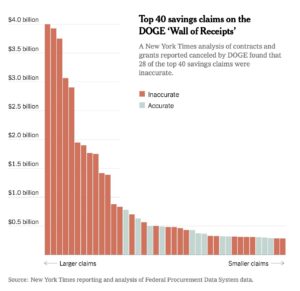
Screenshot via The New York Times.
The top 13 contracts claimed by DOGE “were all incorrect,” reported the Times, highlighting how the top two were for Defense Department contracts Musk claimed were “terminations” that had saved $7.9 billion.
“That was not true. The contracts are still alive and well, and those savings were an accounting mirage.”
Among the 40 biggest claims listed by DOGE, only 12 “appeared accurate” by “reflecting real reductions in what the government had committed to spend,” reported the Times.
Throughout its short history, DOGE had repeatedly “listed real cuts alongside fake ones, and made it hard to tell the difference,” which “raised the question of whether DOGE, at its heart, was an exercise in budget cutting or in deception.”
There were “errors and exaggerations” across the work by Musk’s team, the Times found, claiming bogus or inflated savings and even the cuts that were real still “amounted to little,” because DOGE “did not confront the largest (and growing) components of the federal budget: health care programs like Medicare and Medicaid; Social Security; and interest on the federal debt.”
Among the errors found by the Times were double-counting (for example, a cancelled Department of Energy grant that was counted twice, duplicating $500 million in savings), timeline misrepresentations (claiming credit for cancelling contracts that were terminated during the Biden administration or had expired on their own terms), and claiming the full credit for the maximum approved level of a contract even though actual spending was far lower, claiming contracts were cancelled that were resurrected by court rulings or never cancelled at all, and just plain exaggerating the cuts that were made:
In 16 cases, DOGE greatly exaggerated its cuts. Many, including those two large Defense Department contracts, relied on an accounting trick that produced “savings” with little real-world effect. DOGE lowered the official “ceiling value” of contracts — reducing the theoretical limit on what the government could eventually pay — without changing its actual spending.
“Does lowering the maximum limit on your credit card save you any money?” said Travis Sharp, a senior fellow at the Center for Strategic and Budgetary Assessments, which studies federal spending. “No, it does not.”
Some of the other cuts were inefficient by their design, such as cancelling work by outside analysts who provide reports on the effectiveness of taxpayer-funded programs and how to improve them, or by demanding agencies cut a specific dollar amount without considering the work they were doing, if cancelling it would create additional costs down the line. Sometimes the cancellation itself would be wasteful, like where a study had spent years gathering data and DOGE wanted to cancel its grant right before the data collection was complete and the analysis produced.
Read the Times report here.