


When shooting a firearm, one gets to experience Newton’s Third Law of Motion. It states, “For every action, there is an equal and opposite reaction.” In the firearms community, we refer to that motion as recoil, to some degree. Every shooter is made aware of recoil, no matter what type of firearm they are using.
Why use muzzle brakes?
Many people are very sensitive to recoil and their shooting suffers tremendously because of it. Machismo aside, the more powerful the firearm, the greater the recoil, and the more uncomfortable the firearm is to shoot. I have fired everything from .22 CB caps to .470 Nitro Express cartridges, and I am here to tell you, the big bruisers can be painful to shoot for extended strings.

That is especially true when sighting them in or working up a handload off the bench where all human error must be eliminated. Another aspect of recoil is the tendency for the muzzle to rotate up. That rotation is a direct result of the design of the grip, stock, and human anatomy. It is especially noticeable with handguns because the gun is not supported on the shoulder and the wrist. If not locked, it will rotate up.

Depending on the type of handgun you are shooting, that rotation can be controlled somewhat with the correct shooting technique — depending on the type and size of the handgun, and the grip and strength of the shooter. This exaggerated effect is called muzzle climb or muzzle rise, although more recently some have coined the phrase “muzzle flip” which I personally don’t care for because “flip” connotes a lack of control.

Let’s first examine how this occurs. When a firearm is discharged, there are many forces that act upon it. The most significant are the gases generated by the burning propellant, which propel the bullet down and out the barrel. As previously stated, “For every action, there is an equal and opposite reaction.” Meaning that energy also pushes back on the firearm into the shooter.
It must be noted that the weight of the projectile also has an effect on the recoil energy generated. An example would be a shooter firing a 180-grain bullet out of a .30-06 would feel more recoil than if he fired 150-grain bullet out of the same rifle. E=mc2.
Lots of tinkerers have tried to tame these effects over the years and have come up with some pretty ingenious solutions, including shock absorbers that go in the stock. I never cared for those because they threw the balance of a rifle off and did not control the rising of the muzzle. As for handguns, some grips are purposely designed to allow the muzzle to rotate up as the wrist allows that rotation. Conversely, combat handguns are designed to be fired with a locked wrist, so the recoil is controlled, and the gun remains on target for fast follow-up shots.

I tried porting and compensators early on and found that they did in fact keep the muzzle down. However, the flash was redirected up and was very distracting — especially in low light situations.
What one must understand is that everything you cut into or hang on the end of a barrel is equal in the sense that it is redirecting the gases to counter something. Ports, mostly found on handguns, direct most of those escaping gases upward, thereby pushing the muzzle down. However, they don’t do much about the recoil to the rear.
Ports are designed to counteract the torque on the pistol that is forcing your wrist to rotate up, while your wrist is in turn trying to push the muzzle down and point at the target. Porting basically, involves drilling or cutting precise openings near the end of the barrel, which allows some of the gases behind the bullet to escape.

Primarily designed for the gases to vent upwards as the bullet is exiting the barrel, thereby pushing the barrel down. Ports do that well, but again, they are less effective at addressing the forces moving rearward. There are many approaches to ports on handguns, and yes, I have tried several of them as shown by the photos.
Types of Brakes
As you can also see in the accompanying photos, compensators and muzzle brakes are different than ports in what and how they accomplish what they do. Muzzle brakes can be machined integrally, near the muzzle of the barrel, but most often consist of a barrel extension. The brakes usually contain several openings cut along their sides, top, and bottom.
These openings allow the gases to escape at various angles to the muzzle, which not only helps reduce the muzzle climb, but also counteracts and reduces the movement to the rear, i.e., the recoil of the weapon. As for ports, compensators, or brakes on firearms, there was a time when I felt like I had spent lots of time and money with nothing really effective to show for it.

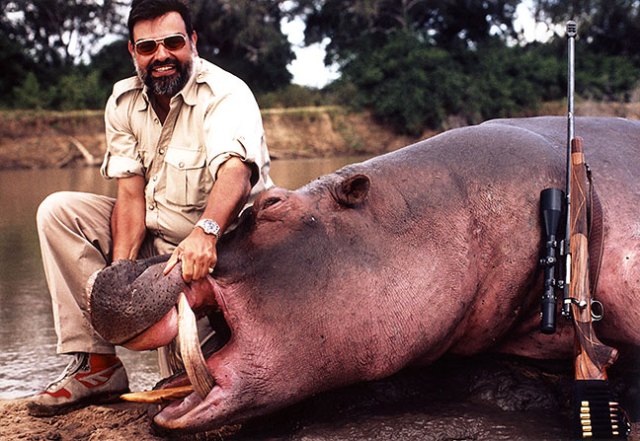
As faith would have it, back in the “Age of Dinosaurs” (See the proof in the accompanying photo) I was on a varmint hunt with friends and retired predator control officer Herb Brusman in Oregon when one day, we got rained out. Herb asked if I would mind taking a ride with him to pick up a rifle that he had made up in .338/378.
During the ride, I gave Herb some good-natured jabs about why he would want something that punishing to shoot. I told him that you could only kill something so dead. He replied he needed it for those really long shots on elk. We arrived at the shop of Wayne Davidson, and Herb was understandably excited about getting his rifle and shooting it.


I noticed a huge ugly thing attached to the end of the barrel and asked what in the world it was. Wayne replied that it was a combination muzzle brake and compensator of his own design, and he guaranteed it to work. Of course, in my smart-ass way, I exclaimed, Yeah Right! At which point, he took a handful of shells and challenged me to take it out back and shoot it with the statement, “Just place it on the palm of your hand, lightly against your shoulder, and press the trigger. I guarantee it will not move.”
No Thanks! How dumb do I look? Well, Herb was anxious to try it, so off we went. He loaded it up and touched it off, Now, I fully expected him to be knocked over, but I did not see any effect. He turned to me and said, “This is amazing you’ve got to try it.” I must admit, my curiosity was getting the better of me so I figured if he could, I could.
Now I had fired many express rifles and big boomers, so I assumed a stance and grip as if a .458 Lott was being mounted and pressed the trigger. To my amazement, other than it being loud, I felt almost nothing. I asked herb if I could try it one more time.

For the second shot, I followed Wayne’s instructions, placing it on the palm of my hand and lightly against my shoulder. In the back of my mind, I thought it was a trick with a light load in the first round to pay me back for my big mouth. To my amazement, again, the rifle did not move.
When we got back to Wayne’s shop, I was offered up some humble pie and asked if he could provide some of his muzzle brakes for my rifles. One of the included photos shows the first such brake Wayne provided for my .338 Win Mag beater rifle. Wayne’s brake combined all three of those solutions in one device but it sure is ugly and very loud — if you’re standing to the side. He also solved the problem of using one of those devices prone — no dirt gets kicked up.
My next African Safari was to Zambia with PH John Coleman. On that Safari, I was armed with the .338 Win Mag and a .375 H&H — both sporting Wayne’s muzzle brakes. One evening, during Sundowners, John commented on how he had never seen anyone call his shots as accurately as I had been doing.

I did not have the heart to tell him that I wasn’t calling my shots, I was seeing the bullets hit. He was also pretty vocal about not liking the muzzle blast he was being forced to endure, which was VERY loud as you can see by John’s reaction in the photos.
When I returned from Africa, I called to thank Wayne. He put me in contact with gun scribe Earl Etter who was doing an article on brakes for Gun Digest, if memory serves. He was also taken with Wayne’s work and stated that of all the compensators and brakes he had tested, Wayne’s was the only one that really worked.
Final Thoughts
As long as I am talking about brakes, could someone please explain to me why the state of Komiefornia thinks brakes are less lethal than flash suppressors? Flash suppressors only suppress the muzzle flash. Brakes keep you on target enabling faster follow-up shots… Politicians… Go figure! That said, I discourage the use of brakes on tactical (AR) rifles, because of the disruptive muzzle blast that will affect anyone near you — even with the best hearing protection.
Have you had good luck with any particular muzzle brakes? What about porting? Share your answers in the comment section.